


** Fluid Rendering in VR Mode is fully supported from v4 onwards **
-- Contents:
- Fluid Dynamics script files.
- Plugin preset files containing various fluid presets like Honey, Cornsyrup, Green Goo... etc.
- Three demo scenes:
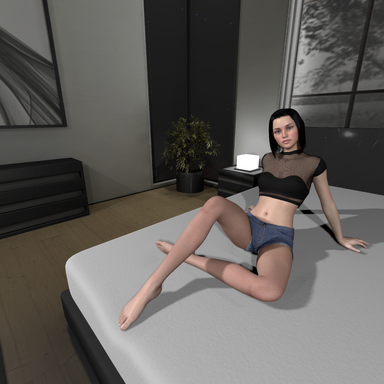
*Demo scene #1: to demonstrate settings to use for sticky fluid on female atom.
*Demo scene #2: to demonstrate various fluid particle physics parameters.
*Demo scene #3: to demonstrate cohesion & viscosity simulation & collision with person skin.
-- How to use?
- Simply load the FluidDynamics.cslist script file on an Empty atom or CUA Atom, the atom control Z axis is going to be the fluid emission direction.
-- Description & main features:
- Particle based fluid simulation that runs fully on the GPU using compute shaders, with some optimizations like spatial hashing to make 100k+ particles doable in real-time.
- Simulation physics logic is based on the Smoothed Particle hydrodynamics method or ''SPH'' for short.
- Two rendering methods available for selection:
1. Raymarch: Volumetric 3D fluid rendering for max quality.
2. Composite: Screen-space fluid surface for max performance.
- Preset System.
- Full Animation Support: Every slider, Toggle or Button in the plugin can be controlled with timeline animations.
- Extra features like hard stickiness which allow particles to be stuck to person colliders or any primitive/ mesh colliders in scene.
- Primitive collider support, collides with all primitive colliders in scene. (sphere, box, plane & capsule colliders)
- Experimental Mesh collider support, Only use if environment is well optimized. (uses low res proxy mesh collider)
-- Important Notes:
- The main parameters that will affect performance are the following:
- Simulation Smoothing Radius: This determines how far to look for neighbouring particles. More radius distance = more realism but with added impact on performance. (generally you can keep it at the default 0.15 and increase the density for a more defined simulation)
- Pressure: incompressibility simulation forces, the lower it is the denser & higher resolution the particles become. setting it too low will hurt fps.
- Rest Density: This is the target particle density per cubic meters, Higher values are more realistic but with added fps impact.
- Fluid Resolution Scale: This downscales the rendered screen space fluid for performance. For 1440p monitors 0.5 is a good balance, You might wanna lower this value if your monitor is 4K for example.
- Anisotropy: This flattens the spherical particles into ellipsoids for the composite renderer to smooth out the final rendered fluid, disabled by default as it is still in experimental stage.
- Render Camera: Choose which camera to render the fluid on exclusively, by default this is set to Auto which will render on all currently active cameras. choose "MonitorRig" to render only on player view for max performance.
- The other parameters are essentially pretty straight forward, like adjusting fluid color or stickiness... etc.
- Tooltips system for a brief explanation on every UI parameter.
-- Tips:
- You can use timeline to animate emission in spurts.
- You can use Parenting plugins like Bone Control to parent the fluid emitter to genitals. (native support for genital orifices will be added in later updates)
-- Quick Preview of fluid material & physics properties:
-- Snaps:


-- Scenes in Package:

-- Plugin Reference Credits:
- @MacGruber for Utils script, Used to fetch compute shaders & surface shaders from .assetbundle file.
-- Contents:
- Fluid Dynamics script files.
- Plugin preset files containing various fluid presets like Honey, Cornsyrup, Green Goo... etc.
- Three demo scenes:
*Demo scene #1: to demonstrate settings to use for sticky fluid on female atom.
*Demo scene #2: to demonstrate various fluid particle physics parameters.
*Demo scene #3: to demonstrate cohesion & viscosity simulation & collision with person skin.
-- How to use?
- Simply load the FluidDynamics.cslist script file on an Empty atom or CUA Atom, the atom control Z axis is going to be the fluid emission direction.
-- Description & main features:
- Particle based fluid simulation that runs fully on the GPU using compute shaders, with some optimizations like spatial hashing to make 100k+ particles doable in real-time.
- Simulation physics logic is based on the Smoothed Particle hydrodynamics method or ''SPH'' for short.
- Two rendering methods available for selection:
1. Raymarch: Volumetric 3D fluid rendering for max quality.
2. Composite: Screen-space fluid surface for max performance.
- Preset System.
- Full Animation Support: Every slider, Toggle or Button in the plugin can be controlled with timeline animations.
- Extra features like hard stickiness which allow particles to be stuck to person colliders or any primitive/ mesh colliders in scene.
- Primitive collider support, collides with all primitive colliders in scene. (sphere, box, plane & capsule colliders)
- Experimental Mesh collider support, Only use if environment is well optimized. (uses low res proxy mesh collider)
-- Important Notes:
- The main parameters that will affect performance are the following:
- Simulation Smoothing Radius: This determines how far to look for neighbouring particles. More radius distance = more realism but with added impact on performance. (generally you can keep it at the default 0.15 and increase the density for a more defined simulation)
- Pressure: incompressibility simulation forces, the lower it is the denser & higher resolution the particles become. setting it too low will hurt fps.
- Rest Density: This is the target particle density per cubic meters, Higher values are more realistic but with added fps impact.
- Fluid Resolution Scale: This downscales the rendered screen space fluid for performance. For 1440p monitors 0.5 is a good balance, You might wanna lower this value if your monitor is 4K for example.
- Anisotropy: This flattens the spherical particles into ellipsoids for the composite renderer to smooth out the final rendered fluid, disabled by default as it is still in experimental stage.
- Render Camera: Choose which camera to render the fluid on exclusively, by default this is set to Auto which will render on all currently active cameras. choose "MonitorRig" to render only on player view for max performance.
- The other parameters are essentially pretty straight forward, like adjusting fluid color or stickiness... etc.
- Tooltips system for a brief explanation on every UI parameter.
-- Tips:
- You can use timeline to animate emission in spurts.
- You can use Parenting plugins like Bone Control to parent the fluid emitter to genitals. (native support for genital orifices will be added in later updates)
-- Quick Preview of fluid material & physics properties:
-- Snaps:
-- Scenes in Package:
-- Plugin Reference Credits:
- @MacGruber for Utils script, Used to fetch compute shaders & surface shaders from .assetbundle file.